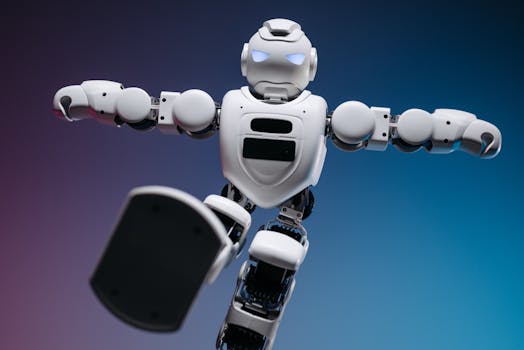

Have you ever stopped to consider the quiet revolution happening all around us, driven by machines that can not only move but also think? The convergence of artificial intelligence (AI) and robotics is no longer the stuff of science fiction; it’s a palpable force reshaping industries, enhancing our daily lives, and pushing the boundaries of what’s possible. But beneath the surface of sleek metallic exteriors and intricate machinery lies a sophisticated intelligence – the AI that breathes life and purpose into these mechanical marvels. So, how exactly is AI being used in robotics to achieve these extraordinary feats?
This isn’t just about robots following pre-programmed paths anymore. We’re witnessing a paradigm shift where robots are becoming adaptable, perceptive, and even intuitive. They are learning, making decisions, and interacting with their environments in ways that were once unimaginable.
From Simple Tasks to Complex Cognition: The AI-Powered Evolution
At its core, AI empowers robots with capabilities that mimic human intelligence, albeit in a specialized form. This allows them to perceive their surroundings, understand context, learn from experience, and execute actions autonomously. The integration is so profound that it’s often hard to separate the robot’s hardware from its “brain.”
Think about it: a robot arm in a factory can now go beyond repetitive welding. With AI, it can inspect parts for defects, adapt its grip based on an object’s shape and fragility, and even collaborate with human workers more safely and efficiently. This adaptability is a direct result of AI algorithms processing vast amounts of data in real-time.
#### Machine Learning: The Robot’s Teacher
A significant driver behind this evolution is machine learning (ML), a subset of AI. ML algorithms enable robots to learn from data without being explicitly programmed for every single scenario.
Pattern Recognition: Robots use ML to identify objects, recognize faces, and detect anomalies in their environment. This is crucial for autonomous navigation and quality control.
Predictive Maintenance: By analyzing sensor data, ML can predict when a robot might malfunction, allowing for proactive repairs and minimizing downtime.
Skill Acquisition: Through reinforcement learning, robots can be trained to perform complex tasks by trial and error, receiving “rewards” for successful actions. I’ve seen this firsthand in simulations where a robotic arm learns to pick and place delicate items with astonishing precision after thousands of attempts.
Enhancing Perception: Seeing and Understanding the World
For a robot to be truly intelligent, it must first be able to perceive and understand its environment. AI plays a pivotal role in equipping robots with advanced sensory capabilities.
#### Computer Vision: The Robot’s Eyes
Computer vision, powered by deep learning, allows robots to “see” and interpret visual information. This goes far beyond simple image recognition.
Object Detection and Tracking: Robots can identify and follow specific objects, essential for tasks like autonomous driving, warehouse management, and surgical assistance.
Scene Understanding: AI enables robots to comprehend the layout of a space, identify obstacles, and navigate complex terrains safely. Imagine a search-and-rescue robot mapping a collapsed building, differentiating between rubble and potential survivors.
3D Mapping and Localization: Robots can build detailed 3D models of their surroundings, allowing them to know their precise location and plan optimal routes.
#### Beyond Sight: Integrating Other Senses
While vision is prominent, AI also enhances other sensory inputs. Haptic feedback allows robots to “feel” textures and pressure, crucial for delicate manipulation tasks. Advanced AI algorithms can fuse data from multiple sensors – cameras, lidar, sonar, microphones – to create a richer, more robust understanding of the robot’s context.
Smarter Movement and Navigation: The Art of Autonomy
One of the most visible applications of AI in robotics is in enabling autonomous movement and navigation. Whether it’s a self-driving car or a drone exploring an uncharted territory, AI is the guiding force.
#### Path Planning and Decision Making
AI algorithms analyze sensor data to create optimal paths, avoid unexpected obstacles, and make real-time decisions. This involves complex calculations for trajectory optimization and risk assessment.
Dynamic Environments: Robots can adapt their navigation strategies on the fly when faced with changing conditions, such as moving pedestrians or fluctuating traffic.
Cooperative Navigation: In multi-robot systems, AI allows robots to coordinate their movements, avoiding collisions and working together to achieve a common goal, like efficiently managing a large warehouse.
Human-Robot Interaction: Building Bridges, Not Barriers
As robots become more integrated into our lives, their ability to interact with humans seamlessly and safely is paramount. AI is central to this development.
#### Natural Language Processing (NLP): Understanding and Communicating
NLP allows robots to understand human speech and respond in a way that’s natural and intuitive. This is transforming customer service robots, assistive devices for the elderly, and even collaborative robots on factory floors.
Voice Commands: Robots can now understand complex instructions and respond to queries, making them more user-friendly.
Contextual Understanding: Advanced NLP allows robots to grasp the nuance and intent behind human communication, leading to more meaningful interactions.
#### Social Robotics and Empathy (Emerging Areas)
While still in its nascent stages, AI is being explored to imbue robots with social intelligence. This involves understanding human emotions, gestures, and social cues to foster better collaboration and companionship. Think of robots that can detect user frustration and adjust their behavior accordingly.
The Future is Now: Where AI and Robotics Take Us Next
The question “How AI is being used in robotics” has an ever-expanding answer. We’re moving beyond simple automation towards true collaboration and intelligent assistance. From performing intricate surgeries with unparalleled precision to exploring the depths of the ocean or the vastness of space, AI-powered robots are our partners in discovery and progress.
The continued advancement in AI – particularly in areas like explainable AI (XAI), which aims to make AI decisions transparent, and edge AI, enabling robots to process information locally without constant cloud connection – will only further accelerate this integration. We can expect robots that are not just tools, but intelligent agents capable of learning, adapting, and contributing to society in profound new ways. The future of robotics is undeniably intelligent, and AI is the architect of this remarkable transformation.